
Oct 20, 2026 · @Youssef
Garmin Forerunner 265 Reviews: Is This AMOLED Running Watch Still Worth It in 2026?
Is a running watch launched in 2023 still a smart buy in 2026? After digging through dozens of garmin forerunner 265 reviews and Garmin’s own spec sheets, my honest answer is yes, with a few caveats you should know about before you click buy.
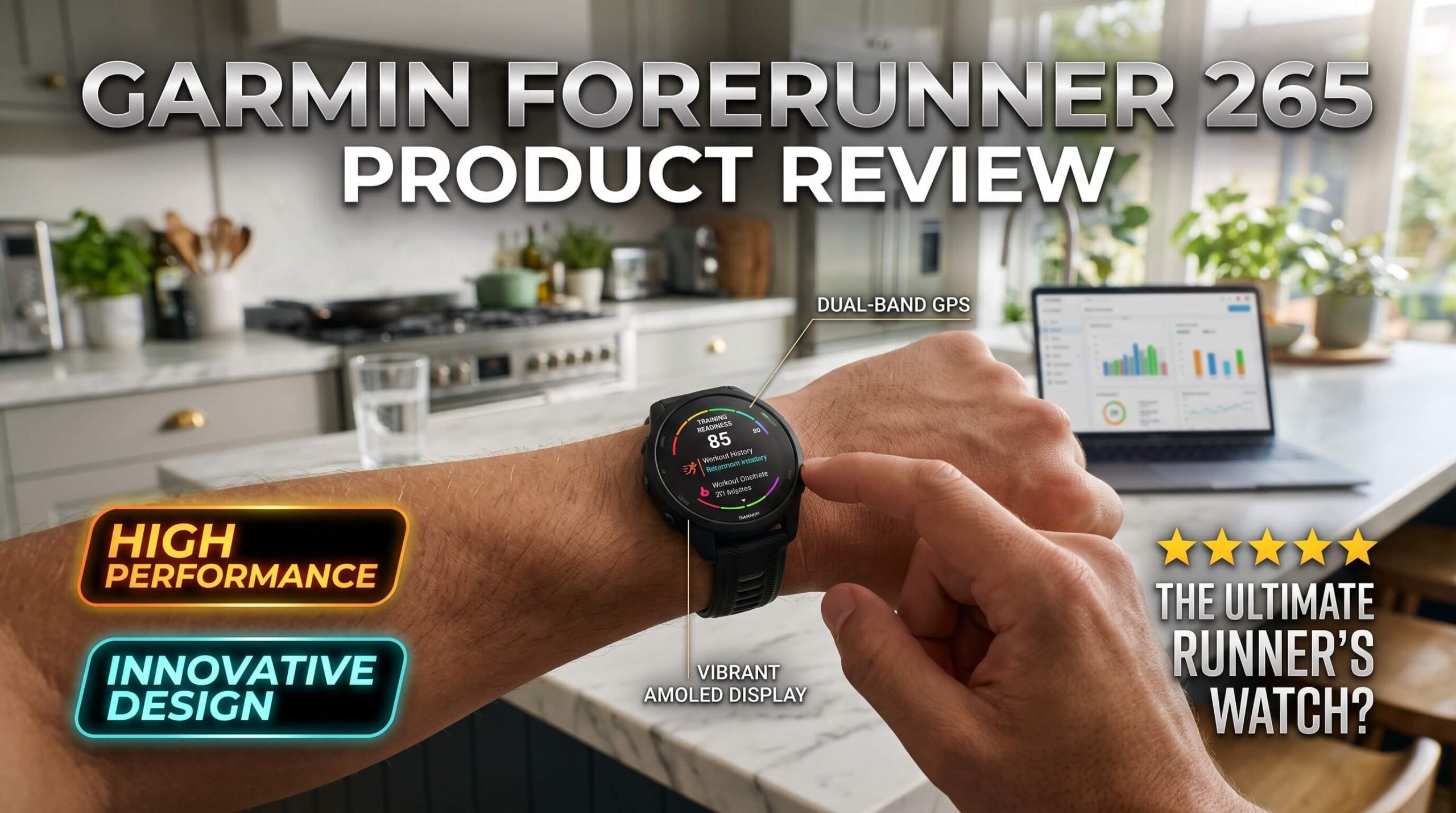
The Garmin Forerunner 265 smartwatch pairs a bright AMOLED touchscreen with multi-band GPS and Garmin’s Training Readiness score. It weighs just 47 grams (39 grams for the smaller 265S), and Garmin rates the battery at up to 13 days in smartwatch mode and 20 hours of GPS tracking.
I’m reviewing the Forerunner 265 because it sits right in the middle of Garmin’s running lineup, and it’s the model most runners ask about: is it worth paying more than the entry-level watches, or should you hold out for something newer?
To make the decision easy, I’ve organized this review around 8 key facts: who the watch is for, how it looks, how it performs, how easy it is to use, how well it’s built, whether it’s good value, how it compares with alternatives, and what buyers ask most.
Table of Contents
Key Fact 1: Who Should Buy the Garmin Forerunner 265?
The Garmin Forerunner 265 is built for runners who want serious training data without paying flagship prices. If you’re training for a 5K, 10K, half marathon or marathon and want guidance on when to push and when to rest, this is the kind of watch reviewers keep recommending.
The Forerunner 265 is a great fit if you:
- run three or more times a week and follow a training plan
- want a bright AMOLED screen that is easy to read in daylight
- need reliable GPS in cities or under tree cover, where multi-band tracking helps
- want a smartwatch that lasts days, not hours, between charges
- like the idea of leaving your phone at home and running with music on your wrist
It’s probably not for you if you:
- want to take phone calls from your wrist (that feature arrived on the newer Forerunner 570)
- only need step counts and basic heart rate, since a cheaper fitness tracker will do the job
- want the longest possible GPS battery, because the older Forerunner 255 was rated for 30 hours of GPS versus 20 hours on the 265
- race triathlons or ultras and need the deeper tools found on Garmin’s higher-end models
Garmin Forerunner 265 Reviews at a Glance: Product Summary Box
| Detail | Garmin Forerunner 265 |
|---|---|
| Product | Garmin Forerunner 265 GPS running smartwatch (265 and smaller 265S) |
| Display | AMOLED touchscreen (416 x 416 on the 265, 360 x 360 on the 265S) |
| Weight | 47 g (265) / 39 g (265S) |
| Battery life | Up to 13 days smartwatch mode, 20 hours GPS (265S: 15 days, 24 hours) |
| Standout features | Multi-band GPS, Training Readiness score, music storage, Garmin Pay |
| Launch price | $449.99 |
| Recent street price | Roughly $300 to $350 during sales; check the live price on Amazon |
| Star rating | 4.5 / 5 |
Key Fact 2: Garmin Forerunner 265 Design and Appearance
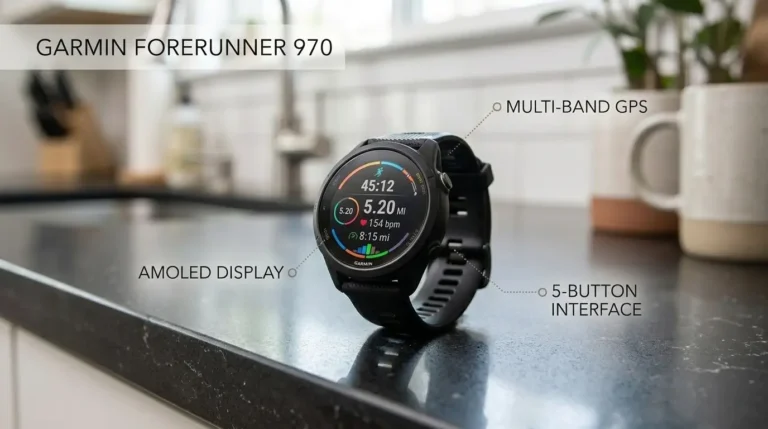
The biggest design upgrade on the Garmin Forerunner 265 is the screen. Garmin swapped the simpler display of older Forerunners for a vivid AMOLED touchscreen, and it makes a historically utilitarian running watch look genuinely stylish. Reviewers repeatedly call it the best-looking Forerunner to date.
On the wrist, the Forerunner 265 feels light. The standard model weighs 47 grams and the 265S weighs 39 grams, so it won’t tug at your arm on long runs or bother you in bed during sleep tracking. The textured silicone strap is soft and comfortable, and Garmin sells the watch in several colors, from understated black to bolder shades like pink and aqua.
You still get Garmin’s classic five-button layout, three on the left and two on the right. That matters on rainy or sweaty runs, when a touchscreen alone can be frustrating. You can swipe through screens on dry days and fall back on the buttons whenever you need to.
If you want a smaller watch, the 265S is the better pick for slim wrists. [IMAGE: side-by-side photo of the 265 and 265S. Alt text: Garmin Forerunner 265 and 265S size comparison]
Key Fact 3: Garmin Forerunner 265 Performance and Features
This is where the Forerunner 265 earns its reputation. It packs most of the training tools from Garmin’s pricier watches into a mid-range body.
Training and recovery tools
- Training Readiness: a daily score that blends sleep, recovery time, HRV and recent training load to tell you whether today is a hard day or an easy one. This was the headline upgrade over the Forerunner 255.
- Body Battery and sleep tracking: an energy score built from stress, sleep and activity, so you can see when you’re running on empty.
- Running metrics: pace, cadence, training status, race predictions and wrist-based running power, all without extra accessories.
GPS accuracy
The Forerunner 265 supports multi-band GPS, which helps it hold a clean signal between tall buildings and under trees. Reviewers who tested it side by side with other watches describe the tracking as super accurate, though multi-band mode does use more battery than standard GPS.
Music, payments and smart features
You can load music onto the watch and run with Bluetooth headphones, and Garmin Pay lets you tap to pay without your phone. Notifications from your phone appear on the AMOLED screen, though you can’t reply to calls from the wrist.
Battery life
Garmin rates the 265 at up to 13 days in smartwatch mode (15 days for the 265S) and 20 hours of GPS tracking (24 hours for the 265S). Real-world use is lower: one reviewer who ran daily and kept notifications on got four to five days per charge, and listening to music during GPS tracking cuts the rated runtime to around seven hours. For most runners that is still comfortable, since a full charge takes about an hour.
The trade-off is clear. The AMOLED screen costs you battery compared with the older Forerunner 255, which offered 14 days and 30 hours of GPS.
Key Fact 4: How Easy Is the Garmin Forerunner 265 Smartwatch to Use?
Setup is simple. You pair the watch with the free Garmin Connect app on iPhone or Android, enter basic details like your age, height and weight, and the watch starts tracking right away. Once the watch is charged and updated, you’re ready to run.
Day-to-day use is friendly too. The touchscreen handles swiping through widgets and glances, while the physical buttons start and stop activities, so you rarely fumble mid-run. Reviewers note that the screen isn’t quite as buttery smooth as an Apple Watch, which is a fair trade for a watch that lasts several times longer on a charge.
The learning curve comes from the sheer amount of data. Training Readiness, HRV status, Body Battery and recovery time are useful, but new runners can feel overwhelmed at first. My advice is to ignore everything except Training Readiness and your pace for the first two weeks, then add metrics one at a time. Garmin Connect also lets you customize which data fields appear on each run screen, so you only see what you care about.
Key Fact 5: Garmin Forerunner 265 Durability and Build Quality
The Forerunner 265 is built for daily training. The display is protected by Corning Gorilla Glass, the case is lightweight but sturdy, and the watch is water-rated for pool and open-water swimming as well as rainy runs. The silicone strap is soft, easy to rinse after sweaty sessions, and can be swapped for any standard quick-release band if it wears out.
Long-term reliability is the hardest thing to judge in a review, so keep two points in mind. First, Garmin’s Forerunner line has a strong reputation for holding up under heavy use, and the reviews I’ve read don’t point to any widespread defect on the 265. Second, like every smartwatch, the battery will slowly lose capacity after a couple of years of daily charging, and an AMOLED screen is more sensitive to heavy scratches than a basic display.
A cheap screen protector and a quick rinse after salty or chlorinated water are enough to keep the watch looking new.
Key Fact 6: Is the Garmin Forerunner 265 Good Value for Money?
The value story has changed since launch. When the Garmin Forerunner 265 arrived at $449.99, several reviewers called it a strong watch with a price that was hard to justify, noting a big jump over the Forerunner 255. That complaint has mostly faded.
Garmin’s newer Forerunner 570 launched at $549.99 and is positioned as the 265’s replacement, which pushed the older watch into sale territory. Recent deals have put the Forerunner 265 at roughly $300 to $350, and a limited Amazon sale in late 2025 dipped to about $300.
At those prices you get an AMOLED display, multi-band GPS, Training Readiness, music storage and Garmin Pay for around the cost of an entry-level smartwatch. That is excellent value for a runner who wants real training insight.
My rule of thumb: if you can find the Forerunner 265 at or below about $350, it’s a smart buy. Near the original $449.99 price, look hard at the newer models first. Amazon prices move often, so check the live price before deciding.
Garmin Forerunner 265 Pros and Cons
Pros
- Bright, sharp AMOLED touchscreen that makes the watch look modern
- Multi-band GPS with very accurate tracking
- Training Readiness, HRV status and recovery tools that guide your training
- Lightweight and comfortable, at 47 g (39 g for the 265S)
- Up to 13 days of smartwatch battery, far beyond most AMOLED rivals
- Music storage and Garmin Pay for phone-free runs
- Much better value now that street prices have dropped
Cons
- GPS battery life (20 hours) is shorter than the older Forerunner 255
- Music playback during GPS tracking cuts battery life to around 7 hours
- No built-in speaker or microphone, so no calls from the wrist
- Screen animations aren’t as smooth as an Apple Watch
- Older hardware that sits below Garmin’s newest software track
- Launch price was steep, and prices fluctuate on Amazon
Key Fact 7: Forerunner 265 Alternatives and Comparisons
The Forerunner 265 sits between Garmin’s budget and premium running watches. Here’s how it stacks up against the two models most buyers compare it with.
| Watch | Launch price | Best for | Key difference |
|---|---|---|---|
| Garmin Forerunner 165 | $249.99 | Budget-minded runners | Cheaper, but no multi-band GPS |
| Garmin Forerunner 265 | $449.99 | Most runners who want strong training data | Multi-band GPS, Training Readiness and music at a now-lower street price |
| Garmin Forerunner 570 | $549.99 | Runners who want newer features | Built-in speaker and microphone for calls, a brighter screen and newer sensor, but shorter battery life |
Forerunner 265 vs Forerunner 570
The 570 is the newer watch and takes phone calls from the wrist. It also has a brighter display and runs on Garmin’s current software track, so it should receive new features for longer. Reviewers measured shorter battery life on the 570, and with a launch price about $100 higher, it’s hard to call it a must-upgrade. If calls and the very latest features matter, choose the 570. If you’d rather save roughly $200 at current street prices, the 265 is the smarter buy.
Forerunner 265 vs Forerunner 165
The 165 is the budget route into Garmin’s AMOLED running watches. It’s a good pick if you’re new to running and don’t need multi-band GPS. Choose the 265 if you run in cities or wooded areas where GPS accuracy matters.
Key Fact 8: Garmin Forerunner 265 FAQ
Is the Garmin Forerunner 265 still worth buying in 2026?
Yes, especially at the lower prices it now sells for. It keeps the AMOLED screen, multi-band GPS and Training Readiness that made it popular, and it costs far less than the newer Forerunner 570.
What’s the difference between the Forerunner 265 and 265S?
The 265S is the smaller version. It weighs 39 g instead of 47 g and has a smaller display. Garmin rates its battery slightly higher: 15 days in smartwatch mode and 24 hours of GPS, versus 13 days and 20 hours on the standard 265.
Can I swim with the Forerunner 265?
Yes. The watch is water-rated, so it handles pool swimming and rainy runs. Rinse it with fresh water after chlorine or salt water to protect the strap and sensors.
Does the Forerunner 265 work with iPhone and Android?
Yes. It pairs with the Garmin Connect app on both platforms, where you can review your runs, sleep and recovery data.
Can I take phone calls on the Forerunner 265?
No. You’ll see call and message notifications, but there’s no built-in speaker or microphone. The newer Forerunner 570 adds that feature.
Final Verdict: Do Garmin Forerunner 265 Reviews Get It Right?
After weighing the evidence, yes. Garmin Forerunner 265 reviews are overwhelmingly positive because the watch delivers what runners actually need: a gorgeous AMOLED display, accurate multi-band GPS, genuinely useful recovery guidance and battery life that beats most rivals. The main complaint, its launch price, has largely disappeared now that the Forerunner 570 has pushed street prices down.
My rating: 4.5 out of 5 stars. It loses half a star for shorter GPS battery life than the Forerunner 255 and the lack of wrist calls.
If you’re a runner who wants to train smarter, the Forerunner 265 is still one of the best-value Garmin watches you can buy.
Ready to buy? Click here to check the latest price on Amazon and see why the Garmin Forerunner 265 is a top choice for runners who want serious training data without a flagship price.
Author top picks: