
28 oct. 2026 · @Youssef
Forerunner 970 Review: Is Garmin’s Flagship Running Watch Worth $749?
Is the Forerunner 970 worth $749? After comparing hands-on reviews from major outlets with Garmin’s own spec sheets, my answer is yes for the right runner, and a clear no for everyone else.
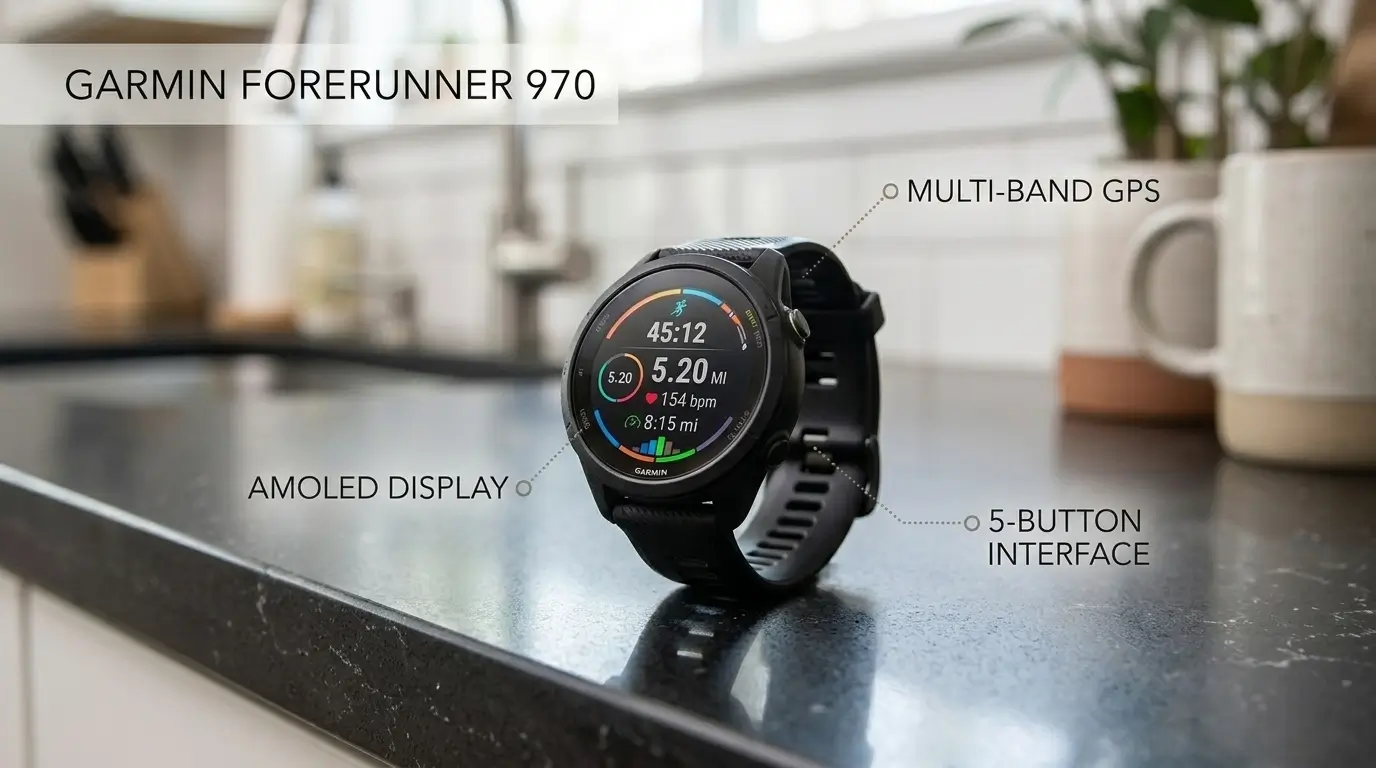
The Garmin Forerunner 970 packs a bright AMOLED display, a sapphire lens, a titanium bezel, multi-band GPS, ECG, a built-in LED flashlight and a speaker and microphone into a 56-gram watch. Garmin rates the battery at up to 15 days in smartwatch mode and 26 hours of GPS tracking.
I’m reviewing the garmin 970 forerunner because it’s the watch runners ask about most when they’re stuck between Garmin’s mid-range and flagship models, and the Forerunner 965 vs 970 question comes up constantly.
To help you decide, I’ve organized this review around 8 key facts: who the watch is for, how it looks, how it performs, how easy it is to use, how well it’s built, whether it’s good value, how it compares with alternatives, and what buyers ask most.
Table of Contents
Key Fact 1: Who Should Buy the Garmin Forerunner 970?
The Forerunner 970 is built for serious runners and triathletes who want Garmin’s most complete runner-first watch and are happy to pay for it. It makes the most sense when you will actually use the extras, because the extras are what you’re paying for.
The garmin forerunner 970 is a great fit if you:
- explore new routes and want full-color offline maps with turn-by-turn navigation
- train before sunrise or after dark and want a built-in flashlight on your wrist
- care about heart health and want ECG readings from your watch
- race triathlons or marathons and want advanced training, recovery and running-form data
- want flagship features in a lightweight 56-gram watch instead of a bulky adventure model
It’s probably not for you if you:
- are new to running or on a tight budget, since the launch price was $749.99
- want the longest possible battery life, because the Forerunner 965 is rated for more
- need a smaller watch, as the 970 only comes in one 47 mm size
- stick to roads you already know and never use maps or a flashlight, in which case the Forerunner 570 or 265 will cover your needs for far less
Forerunner 970 at a Glance: Product Summary Box
| Detail | Garmin Forerunner 970 |
|---|---|
| Product | Garmin Forerunner 970 premium GPS running and triathlon smartwatch |
| Display | 1.4-inch AMOLED touchscreen, 454 x 454 pixels, sapphire lens |
| Build | Titanium bezel, 47 x 47 x 12.9 mm, 56 g, one size only |
| Battery life | Up to 15 days smartwatch mode, up to 26 hours GPS, about 13 to 14 hours GPS with music |
| 3 bold upgrades over the 570 | Full-color offline maps, built-in LED flashlight, ECG |
| Other highlights | Multi-band GPS, Elevate Gen 5 heart rate sensor, speaker and microphone, 32 GB storage |
| Launch price | $749.99 |
| Star rating | 4.5 / 5 |
Quick take: the Forerunner 970 is the most capable Forerunner yet, and the extras are only worth paying for if you will use them.
Key Fact 2: Garmin 970 Forerunner Design and Appearance
The Forerunner 970 looks and feels like a premium watch without shouting about it. It uses a titanium bezel and a sapphire lens, both a step up from the Gorilla Glass and aluminum found on the Forerunner 570. The 1.4-inch AMOLED display is sharp at 454 x 454 pixels, and reviewers say it is roughly twice as bright as the previous model, which makes it far easier to read in direct sunlight.
Despite the extra hardware, the watch stays slim. It weighs 56 grams, only 3 grams more than the Forerunner 965 even with the flashlight and speaker added, and it’s about 0.3 mm thinner. One outlet called it one of the most comfortable GPS watches it has tested. The 22 mm QuickFit band is easy to swap, so you can change the look for races or work.
You still get Garmin’s physical buttons alongside the touchscreen, which is a relief on sweaty or rainy runs. The one design drawback is size: the 970 only comes in a single 47 mm case. If you have a slim wrist, try one on before you commit.
Key Fact 3: Forerunner 970 Performance and the 3 Bold Upgrades
The Forerunner 970 shares most of its training software with the 570, so the real story is what the extra $200 buys. Here are the three upgrades that set it apart.
Upgrade 1: Full-color offline maps
Only the Forerunner 970 has onboard maps. With 32 GB of storage (the 570 has 8 GB), it carries detailed streets, trails and points of interest, plus turn-by-turn navigation and route tools. The 570 offers only breadcrumb navigation, so this is the biggest practical difference between them.
Upgrade 2: A built-in LED flashlight
The 970 is the first Forerunner with a flashlight, and it has both white and red LEDs with several modes. It’s handy for dark starts, walks to the car and emergencies. One reviewer noted that it won’t replace a proper headlamp on night runs, but it’s a genuinely useful backup.
Upgrade 3: ECG readings from your wrist
The upgraded Elevate Gen 5 heart rate sensor adds an ECG app that can detect signs of atrial fibrillation. It’s meant for adults aged 22 and over, and it supports a doctor’s care rather than replacing it.
GPS, sensors and running data
Multi-band GPS keeps your track accurate in cities and under trees, and reviewers rate heart rate, GPS and step accuracy as top-class. New running metrics such as Running Tolerance are included, but some running economy stats need Garmin’s separate HRM600 chest strap. You also get a speaker and microphone for calls when the watch is paired with your phone.
Battery life
Garmin rates the 970 at up to 15 days in smartwatch mode and 26 hours of GPS, dropping to around 21 hours with multi-band and about 13 to 14 hours with music. That’s solid, but it is a step down from the Forerunner 965’s 23 days and 31 hours, because the brighter screen uses more power.
Key Fact 4: How Easy Is the Forerunner 970 to Use?
Setup follows the usual Garmin routine. You pair the watch with the free Garmin Connect app on iPhone or Android, enter your basic details, and the watch is ready to track. A USB-C charging cable comes in the box.
Day to day, the Forerunner 970 is easy to live with. The touchscreen handles menus and map panning, while the physical buttons start and stop activities so you never fumble mid-run. Reviewers also praise the highly customizable data screens, which let you show only the metrics you care about on each run.
The learning curve comes from the sheer depth of features. Between Training Readiness, HRV status, race tools, maps, ECG and triathlon modes, new users can feel overwhelmed. My advice is to start with pace, heart rate and Training Readiness, then add maps and advanced metrics one at a time. If you want Garmin’s newer running economy data, plan on buying the optional HRM600 strap as well.
Key Fact 5: Forerunner 970 Durability and Build Quality
Durability is where the Forerunner 970 justifies part of its price. The titanium bezel and sapphire lens are far tougher than the aluminum and Gorilla Glass on the Forerunner 570. In one comparison, previous non-sapphire Garmins were prone to scratches while the 970’s screen stayed pristine after testing.
The watch is also designed for triathlon and swimming, so rain, sweat and pool water aren’t a problem. Rinse it with fresh water after chlorine or salt water to protect the band and sensors.
Long-term reliability is the hardest thing to judge in any review, and the 970 is still a relatively new watch. Like every smartwatch, its battery will slowly lose capacity after a couple of years of daily charging. Garmin’s Forerunner line has a strong reputation for holding up under heavy use, and the reviews I’ve read don’t point to any widespread defect on the 970.
Key Fact 6: Is the Forerunner 970 Good Value for Money?
The Forerunner 970 launched at $749.99, which is $200 more than the Forerunner 570 ($549.99) and $150 more than the Forerunner 965 ($599.99 at launch). Almost every review mentions the price, and several call it very expensive, though one outlet argued the watch lives up to it.
What the extra money buys is real: offline maps, a flashlight, ECG, a sapphire lens, a titanium bezel, a brighter display, 32 GB of storage and a speaker and microphone. What it doesn’t buy is better battery life, since the 965 outlasts it.
My rule of thumb: the 970 is worth it if at least three of those extras matter to you in daily training. If only one or two do, the 570 or a discounted 965 is the smarter purchase. Amazon prices move often, so check the live price before deciding, and compare it with the 570 and 965 listings side by side.
Forerunner 970 Pros and Cons
Pros
- Full-color offline maps with turn-by-turn navigation, exclusive to the 970 among current Forerunners
- Built-in LED flashlight with white and red modes
- ECG readings from the Elevate Gen 5 heart rate sensor
- Bright AMOLED display with a sapphire lens and titanium bezel
- Top-class accuracy from multi-band GPS and the heart rate sensor
- Lightweight and comfortable at 56 g
- Speaker and microphone for calls, plus 32 GB of storage
Cons
- Very expensive, with a launch price of $749.99
- Shorter battery life than the Forerunner 965 (15 days vs 23 days, 26 hours GPS vs 31)
- Only one 47 mm size
- Some running economy stats need the separate HRM600 strap
- The flashlight won’t replace a real headlamp for night runs
- Much of the training software is shared with the cheaper 570
Key Fact 7: Forerunner 965 vs 970 and the 570 Compared
The two watches most buyers weigh against the Forerunner 970 are its predecessor, the 965, and the cheaper 570. Here is how they compare.
| Feature | Forerunner 965 | Forerunner 970 | Forerunner 570 |
|---|---|---|---|
| Launch price | $599.99 | $749.99 | $549.99 |
| Lens material | Gorilla Glass | Sapphire | Gorilla Glass 3 |
| Offline maps | Yes | Yes | No (breadcrumb navigation only) |
| LED flashlight | No | Yes | No |
| ECG | No | Yes | No |
| Speaker and microphone | No | Yes | Yes |
| Heart rate sensor | Elevate Gen 4 | Elevate Gen 5 | Elevate Gen 5 |
| Smartwatch battery | Up to 23 days | Up to 15 days | Up to 10 days |
Forerunner 970 vs 570
The 570 gives you most of the same training platform for $200 less. The 970 adds offline maps, a flashlight, ECG, a titanium bezel, a sapphire lens, 32 GB of storage and longer battery life. Choose the 970 if you navigate new routes, run in the dark or want premium materials. Choose the 570 if you stick to familiar roads and want to save money. The 570 also comes in a smaller 42 mm size, which the 970 doesn’t.
Forerunner 965 vs 970
The Forerunner 965 vs 970 decision comes down to features versus battery. The 970 adds ECG, a flashlight, a speaker and microphone, a sapphire lens and a brighter screen, but it gives up a lot of battery life (15 days versus 23) and costs $150 more at launch. If you can find a 965 at a meaningful discount and care more about battery per dollar, it’s still an excellent watch. Pick the 970 if you want the newest hardware and health features.
Key Fact 8: Garmin Forerunner 970 FAQ
Is the Forerunner 970 worth it over the 570?
Only if you’ll use what the extra $200 buys: offline maps, the flashlight, ECG, and the sapphire and titanium build. If you mainly run familiar roads, the 570 covers most of the same training features.
What’s the difference between the Forerunner 965 and 970?
The 970 adds ECG, a flashlight, a speaker and microphone, a sapphire lens and a brighter display. The 965 has longer battery life, up to 23 days versus 15, and a lower launch price.
Can the Forerunner 970 take phone calls?
Yes. It has a built-in speaker and microphone, so you can take calls from your wrist while the watch is connected to your phone.
Is the ECG on the Forerunner 970 a medical device?
The ECG app records a reading similar to a single-lead ECG and can detect signs of atrial fibrillation. It’s for adults aged 22 and over and doesn’t replace a doctor’s advice, so talk to a medical professional about any concerns.
Does the Forerunner 970 come in different sizes?
No. It comes in a single 47 mm case. If you want a smaller watch from the same family, the Forerunner 570 is available in 42 mm.
Final Verdict: Is the Forerunner 970 Worth Buying?
For the right runner, yes. The Forerunner 970 earns its reputation as Garmin’s most capable runner-first watch, and its 3 bold upgrades over the 570, offline maps, a built-in flashlight and ECG, are genuinely useful rather than gimmicks. Add the sapphire lens, titanium bezel, accurate multi-band GPS and a comfortable 56-gram body, and you get a flagship that feels special on the wrist.
My rating: 4.5 out of 5 stars. It loses half a star for its high price and for battery life that trails the Forerunner 965.
If you’ll use the maps, the flashlight and the health features, the Forerunner 970 is a top choice for serious runners and triathletes who want a premium watch without going full Fenix.
Ready to buy? Click here to check the latest price on Amazon and see why the Garmin Forerunner 970 is a top choice for serious runners and triathletes.
Author top picks: